
When a couple has been trying to conceive for months or years without success, the moment they decide to seek medical help is one of the most significant decisions of their lives. They are not just choosing a doctor. They are choosing who to trust with something that sits at the very center of their hopes, their marriage, and their sense of the future.
In Chhattisgarh, that choice leads more couples to Dr. Ashish Soni than to any other fertility specialist — not because of advertising, but because of reputation. A reputation built entirely on the way he practices medicine, the outcomes his patients achieve, and the experience of being cared for by someone who treats every case as if it is the only case that matters.
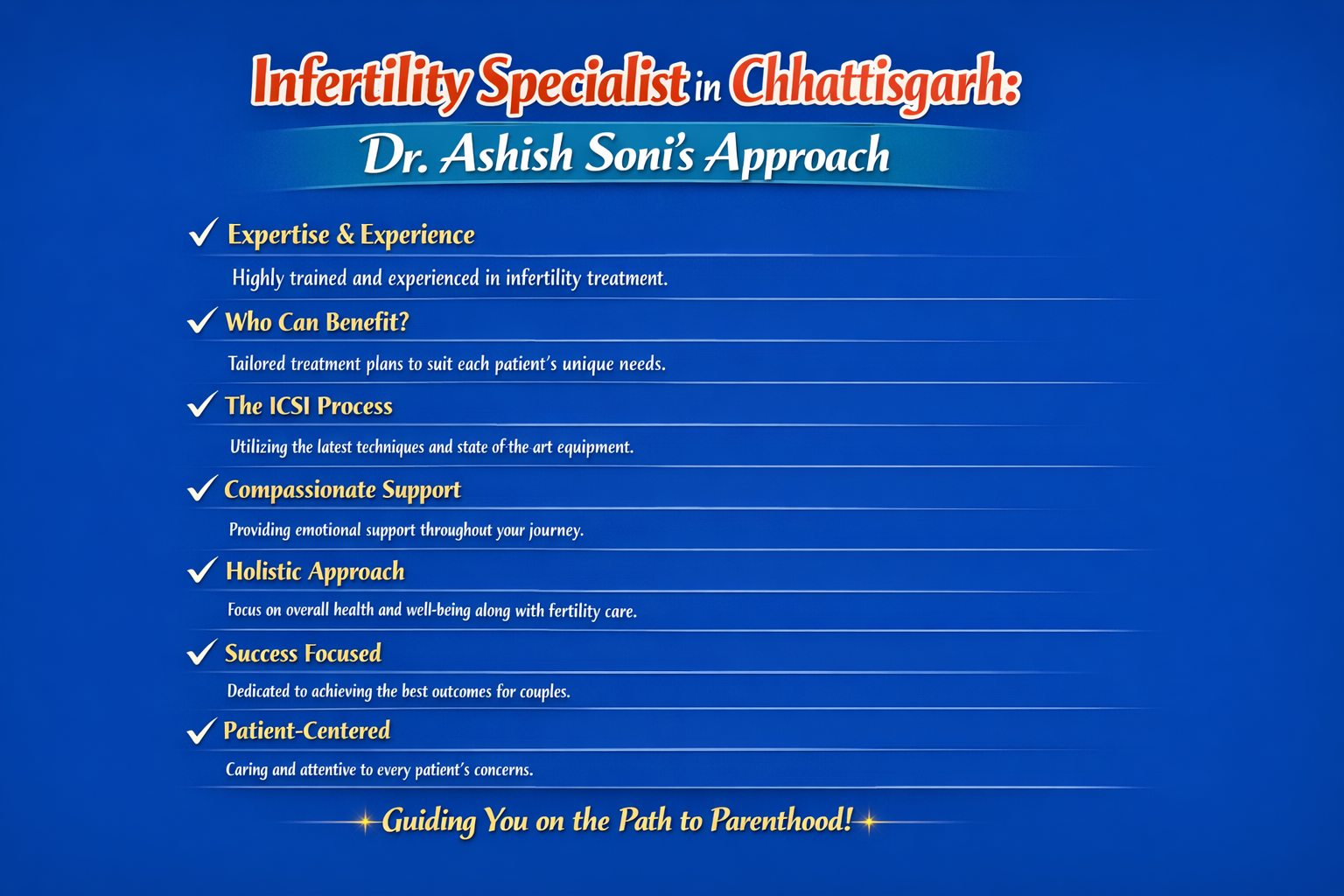
This article is about Dr. Soni's approach — the thinking, the methodology, and the values that define how he practices fertility medicine at Metro IVF Test Tube Baby Center in Ambikapur. It is written for couples who want to understand not just what he does, but how and why he does it.
Who Is Dr. Ashish Soni?
Dr. Ashish Soni is North India's first fertility super specialist — a distinction that marks him as uniquely subspecialized in reproductive medicine in a region where most fertility care is provided by general gynecologists who handle IVF alongside a broad range of other services.
His entire medical career has been devoted to one field: helping couples conceive. He has not divided his practice between deliveries, general surgery, and fertility. He has not treated IVF as one service among many. From the beginning of his career, Dr. Soni chose to go deep into reproductive medicine rather than broad across gynecology — and that focused commitment has produced a depth of expertise that is simply not available elsewhere in North India.
Over the course of his career, Dr. Soni has treated thousands of couples across Chhattisgarh, Jharkhand, Madhya Pradesh, and beyond. He has managed every category of infertility — from mild, easily correctable conditions to the most complex and previously untreatable cases. He has helped couples conceive after fifteen, eighteen, and twenty-two years of trying. He has achieved pregnancies in patients who were told by multiple other specialists that having a biological child was no longer possible.
But beyond the outcomes — which are exceptional — it is his approach that patients describe when they talk about what made the difference.
The Foundation: Listening Before Diagnosing
The first thing that distinguishes Dr. Soni's approach from that of most fertility practitioners is something that sounds deceptively simple: he listens.
Not in the way that a busy doctor listens — half-present, glancing at reports, forming a conclusion before the patient has finished speaking. Dr. Soni listens with the kind of attention that treats the patient's history as the most important diagnostic tool in the room.
In the first consultation, he wants to know everything. Not just the test results and the previous treatment history, but the full story — how long the couple has been trying, what they were told at previous clinics, how those experiences felt, what fears they carry into this appointment, and what they understand about their own condition. He asks questions that most doctors do not think to ask, because he knows that the answers often contain the clue that changes everything.
Patients who come to Metro IVF after years of treatment elsewhere consistently describe this first consultation as a turning point — not because Dr. Soni told them something miraculous, but because he told them something they had never been told before: here is what is actually happening, here is why previous treatments may not have worked, and here is what we are going to do differently.
That clarity — grounded in thorough listening before any diagnosis is made — is the starting point of Dr. Soni's approach. And it is a starting point that most fertility clinics, operating under the pressure of patient volume and time constraints, simply never reach.
The Diagnostic Philosophy: Find What Was Missed
Dr. Soni operates on a principle that shapes every case he takes on, but is especially critical in patients who have already been treated elsewhere without success: never accept a prior conclusion without first questioning every assumption behind it.
When a couple arrives at Metro IVF after one or more failed IVF cycles, or after years of treatment that produced no result, Dr. Soni does not begin by asking how many more cycles they want to try. He begins by asking a different question entirely: what has been missed?
In his experience, the answer to that question is almost always something. A factor that was never tested. A diagnosis that was assumed rather than confirmed. A protocol that was applied without being tailored to the specific patient's biology. A uterine issue that was never visualized. A sperm quality problem that was assessed with a basic test but never investigated at the level the case required.
His diagnostic philosophy is comprehensive by design. Before making any treatment recommendation, Dr. Soni insists on a full evaluation — not just the standard tests that every clinic performs, but the complete picture that includes the tests most clinics skip because they are more expensive, more time-consuming, or simply not part of a routine protocol.
For the woman, this means a full hormonal panel including AMH, FSH, LH, estradiol, prolactin, and thyroid function. It means a detailed pelvic ultrasound with antral follicle count. It means a uterine cavity assessment — hysteroscopy or sonohysterography — to rule out polyps, fibroids, adhesions, or septum that could silently prevent implantation. In cases with a history of repeated failure, it may mean immunological screening, ERA testing to assess endometrial receptivity, or genetic evaluation.
For the man, it means a semen analysis that goes beyond the basic parameters to include sperm DNA fragmentation — a factor that Dr. Soni considers essential information in any case where fertilization has been poor or embryo quality has been inconsistent. It means looking at sperm morphology in detail. And it means asking whether the sperm available — even in low numbers or poor quality — can be optimized through targeted treatment before the IVF cycle begins.
This thoroughness is not about running unnecessary tests. It is about making sure that when treatment is recommended, it is the right treatment — designed for the real problem, not the assumed one.
The Treatment Philosophy: Individualization Over Standardization
Once the diagnostic picture is complete, Dr. Soni builds a treatment plan. And this is where his approach diverges most sharply from the way most fertility clinics operate.
In a volume-driven IVF clinic, protocols are standardized. The same stimulation doses, the same medication sequences, and the same monitoring intervals are applied to most patients because standardization is efficient. It works reasonably well for the majority of straightforward cases. But it fails — sometimes repeatedly — in patients whose biology falls outside the average.
Dr. Soni designs every protocol from the diagnostic findings of that specific patient. The stimulation dose is set according to the woman's AMH level, antral follicle count, and response pattern from any previous cycles. The trigger timing is determined by follicle development in that particular cycle, not by a fixed calendar. The endometrial preparation for frozen embryo transfer is adjusted based on the uterine cavity findings. The sperm preparation method is chosen based on the specific semen parameters and DNA fragmentation result.
This individualization requires significantly more clinical thinking than applying a standard protocol. It requires the doctor to be personally engaged with the details of each case — not delegating protocol decisions to a junior staff member or a template. It is more time-consuming, more demanding, and more intellectually intensive. It is also more effective.
Patients who failed IVF at other clinics on standard protocols — sometimes three or four times — have succeeded at Metro IVF on their first cycle with Dr. Soni, because the protocol addressed what was actually wrong rather than what was conveniently treatable.
The Clinical Values: Honesty Above All
One of the qualities patients describe most consistently when they speak about Dr. Soni is his honesty — even when the honest answer is not the one they were hoping to hear.
Fertility medicine is a field where false hope is easy to sell. Success rate claims can be manipulated. Patients who are desperate to conceive are vulnerable to promises that sound encouraging but are not grounded in a realistic assessment of their specific case. And in an industry where every consultation could lead to a paid treatment cycle, the temptation to over-promise is real.
Dr. Soni does not operate this way. If a couple's situation is genuinely very difficult — if the woman's ovarian reserve is severely diminished, or if the man's sperm quality makes biological fatherhood unlikely — he says so directly. He explains what the realistic options are, what the actual chances look like, and what alternative paths to parenthood exist if biological conception is not achievable.
This honesty is not unkind. It is delivered with warmth, with full acknowledgment of the emotional weight of what the couple is hearing, and with genuine respect for their right to make informed decisions. But it does not shade the truth to keep the consultation pleasant or to encourage a treatment cycle that Dr. Soni does not believe will work.
Patients consistently describe this honesty as one of the most valuable things they received from their first consultation at Metro IVF — not because it was always good news, but because it was real. For couples who had received vague answers or unrealistic promises at other clinics, the clarity of a genuinely honest assessment was itself a form of relief.
The Human Approach: Fertility Treatment Is About People, Not Just Protocols
Dr. Soni often says that fertility medicine cannot be practiced well by a doctor who sees patients only as clinical cases. The couples who come to Metro IVF are not just carriers of diagnostic parameters. They are people who have been living with loss — the monthly loss of a hoped-for pregnancy, the accumulating loss of years, and in many cases the loss of confidence in their own bodies and in the medical system that has not helped them.
His approach to this human dimension of infertility is not performative. He does not add a scripted emotional check-in to the end of a clinical consultation. The warmth and attentiveness are intrinsic to the way he practices — because he genuinely understands that how a couple feels during treatment affects how they cope with uncertainty, how faithfully they follow protocols, and how resilient they are through the difficult stretches of a treatment cycle.
He makes time. Not in the abstract, but concretely — the first consultation at Metro IVF is not rushed to fit a fifteen-minute slot. Questions are welcomed and answered fully. When a result is unexpected or disappointing, Dr. Soni explains it in plain language and immediately redirects toward what the next step looks like. He treats uncertainty — which is inevitable in fertility treatment — with honesty rather than false reassurance.
For couples who have spent years feeling like a number in a waiting room, this experience of being genuinely seen and genuinely listened to is transformative. It does not guarantee a successful pregnancy. But it creates the foundation of trust that makes the entire treatment journey — with all its emotional complexity — navigable.
The Specialization That Sets Dr. Soni Apart: Difficult Cases
If there is one area where Dr. Soni's approach is most distinctively different from that of other fertility practitioners in Chhattisgarh and North India, it is his orientation toward difficult cases.
Many fertility doctors prefer straightforward cases — younger patients with good ovarian reserve, no prior failed cycles, and a clear, treatable diagnosis. These cases have high success rates and are professionally satisfying. Difficult cases — patients with repeated failure, severely compromised fertility parameters, or long histories of unsuccessful treatment — are time-consuming, emotionally demanding, and clinically uncertain.
Dr. Soni actively seeks out these cases. Not because failure is preferable, but because he has found that difficult cases are where genuine expertise makes the most difference. A straightforward IVF case will succeed at almost any competent clinic. A case involving recurrent implantation failure, high sperm DNA fragmentation, severely thin endometrium, or a decade of unexplained infertility requires a level of diagnostic thoroughness and clinical creativity that most clinics simply do not apply.
This orientation has made Metro IVF the destination of choice for couples across Chhattisgarh who have failed elsewhere. And the outcomes — including pregnancies in couples who had been trying for fifteen, eighteen, and twenty-two years — are the evidence that this approach works.
What Patients Experience at Metro IVF
The experience of being a patient under Dr. Soni's care is different from what most couples have experienced at other fertility centers. Several themes emerge consistently from the feedback of patients across Chhattisgarh and beyond.
Clarity. Patients leave their first consultation understanding their situation in genuine detail — what is actually causing the problem, what the realistic treatment options are, and what the honest chances of success look like. This clarity, which most have never received before, is deeply relieving even when the picture is complicated.
Being heard. The experience of having a doctor take the time to understand the full history — the years of trying, the treatments that failed, the emotional weight carried — is something patients describe as different from anything they have experienced in fertility medicine before.
A new explanation. In many cases, Dr. Soni identifies a factor that had been overlooked in previous evaluations — a finding that explains why previous treatments did not work and that points toward a different approach. This new explanation, grounded in a more thorough diagnostic process, restores a sense of direction in couples who had begun to feel that their situation was simply unsolvable.
A plan that makes sense. The treatment plans Dr. Soni designs are explained in plain language, with full reasoning behind every recommendation. Patients understand not just what they are being asked to do, but why — and this understanding makes them active participants in their treatment rather than passive recipients of instructions.
Hope — realistic and grounded. Not the false hope of inflated success rate promises, but the genuine hope that comes from knowing that the right diagnosis has finally been made and the right plan is in place. For couples who had stopped hoping, this is perhaps the most significant thing Metro IVF gives them.
If You Are Looking for an Infertility Specialist in Chhattisgarh
If you are a couple dealing with infertility — whether you are just beginning to seek help or have already been through treatment that did not work — the most important decision you will make is who to trust with your care.
Dr. Ashish Soni's approach to fertility medicine is not defined by the technology he uses or the procedures he performs. It is defined by the depth of his diagnostic thinking, the thoroughness of his evaluation, the honesty of his communication, and the genuine care he extends to every couple who comes to Metro IVF.
North India's first fertility super specialist is here, in Ambikapur — available to patients across Chhattisgarh, Jharkhand, and Madhya Pradesh. And the first step toward the family you have been hoping for is a single consultation.
Metro IVF Test Tube Baby Center Ambikapur, Chhattisgarh metrofertility.in Led by Dr. Ashish Soni — North India's First Fertility Super Specialist
Book your consultation today — and experience what genuinely specialized, genuinely human fertility care feels like.