
When you type "fertility hospital near me" into Google, you are not just searching for an address. You are searching for hope. You are searching for someone who can finally help — after months or years of trying, worrying, and wondering what is wrong.
The results that appear on your screen will show you clinics, hospitals, and fertility centers across Chhattisgarh. Some will look impressive. Some will quote high success rates. Some will have beautiful websites and glowing testimonials. And you will face a question that feels far more overwhelming than it should: how do I choose the right one?
This guide is written to answer exactly that question — honestly, clearly, and in a way that protects you from making a choice you may later regret.
Why Choosing the Wrong Fertility Hospital Is Costly — in Every Way
Before we discuss how to choose well, it is important to understand what is at stake when the wrong choice is made.
Fertility treatment is not like choosing a pharmacy or a diagnostic lab. If you pick the wrong one, the consequences are not minor inconveniences. They are months of wasted time, thousands of rupees spent on cycles that should never have been attempted the way they were, emotional devastation from avoidable failures, and — in some cases — a delayed diagnosis that allowed a correctable problem to go untreated for years.
Couples who eventually reach Metro IVF after failing at other clinics often share a common experience. Their previous clinic was not necessarily dishonest. It was simply not specialized enough, not thorough enough in its diagnostics, and not experienced enough with difficult cases to give them the individualized care they needed.
The cost of the wrong choice is not just financial. It is measured in time — and for a couple dealing with infertility, time is the most precious resource of all.
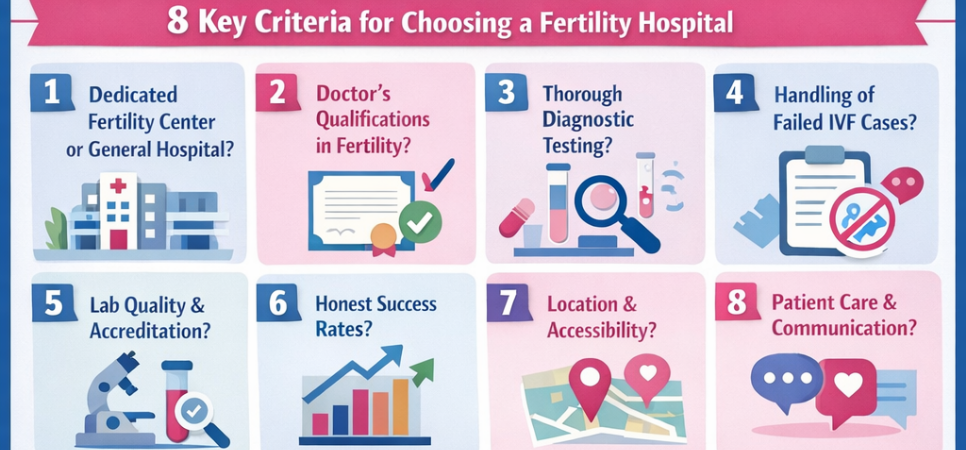
The 8 Most Important Criteria for Choosing a Fertility Hospital in Chhattisgarh
1. Is It a Dedicated Fertility Center, or a General Hospital with an IVF Unit?
This distinction matters more than most patients realize.
A large multi-specialty hospital may have an IVF department as one of thirty or forty services it offers. The doctors running that unit may be qualified gynecologists, but their focus is divided. They perform deliveries, conduct surgeries, manage general women's health, and fit IVF appointments in between.
A dedicated fertility center, by contrast, exists for one purpose only: helping couples conceive. Every doctor, every nurse, every embryologist, every protocol, and every piece of equipment is focused on that single goal. The depth of experience that accumulates in a dedicated center over time is simply not replicable in a general hospital setting.
When searching for a fertility hospital near you in Chhattisgarh, always ask: is this a dedicated fertility practice, or a department inside a larger hospital?
At Metro IVF: Metro IVF Test Tube Baby Center in Ambikapur is a dedicated fertility center. Every patient who walks through the door is here for one reason — and every member of the team is focused entirely on that reason.
2. Who Is the Lead Doctor, and What Are Their Specific Qualifications in Fertility?
The most important person in your fertility journey is your treating doctor. Not the hospital brand, not the building, not the brochure — the doctor.
Ask specifically about the lead doctor's qualifications in reproductive medicine and fertility. An MBBS followed by an MD in Obstetrics and Gynecology is the baseline — but it does not tell you that the doctor has subspecialized in fertility treatment. Look for additional training or fellowship in reproductive medicine, assisted reproductive technology (ART), or reproductive endocrinology.
Also ask: how long has this doctor been practicing exclusively in fertility? A doctor who has spent twenty years in fertility care has seen a range and depth of cases that a doctor who moved into fertility five years ago has simply not encountered yet.
At Metro IVF: Dr. Ashish Soni is North India's first fertility super specialist — a distinction that reflects decades of dedicated, subspecialized training and practice in reproductive medicine. He does not divide his expertise between multiple disciplines. Fertility is his entire focus, and his experience with complex and failed cases reflects that depth.
3. Does the Clinic Perform a Thorough Diagnostic Work-Up Before Starting Treatment?
One of the most common mistakes made by under-specialized fertility clinics is rushing patients into treatment before fully understanding the problem.
A couple comes in, two or three basic tests are done, and within weeks they are starting an IVF cycle on a standard protocol — the same protocol used for every other patient in that clinic. When the cycle fails, the clinic shrugs and suggests trying again.
A genuinely good fertility hospital will insist on a comprehensive diagnostic evaluation before recommending any treatment. This means a full hormonal panel for the woman, a detailed semen analysis including sperm DNA fragmentation for the man, a proper uterine cavity assessment, and in many cases additional tests depending on the history — immunological screening, genetic evaluation, thyroid function, and more.
The diagnostic work-up is not an upsell. It is the most important step in fertility treatment, because you cannot treat what you have not diagnosed.
Questions to ask any clinic: What tests do you run before starting an IVF cycle? Do you test for sperm DNA fragmentation? Do you perform a hysteroscopy before transfer? What do you do differently for patients who have already failed IVF elsewhere?
If the answers are vague or the clinic seems eager to skip straight to starting treatment, that is a serious red flag.
4. How Does the Clinic Handle Failed IVF Cases?
This question alone will tell you more about a fertility hospital's quality than almost anything else.
Every clinic handles straightforward cases adequately. The real test is what happens when a case is difficult — when a patient has failed IVF once, twice, three times. Does the clinic take the time to investigate why the cycle failed? Does it run additional tests, revise the protocol, and approach the next cycle differently? Or does it simply repeat the same approach and hope for a different result?
Ask directly: what percentage of your patients are referred failure cases? What additional investigations do you perform after a failed cycle? Do you have experience with recurrent implantation failure, thin endometrium, poor ovarian response, or sperm DNA damage?
A clinic that hesitates or gives generic answers to these questions is probably not equipped to handle your case if it turns out to be complex.
At Metro IVF: A significant proportion of Metro IVF's patients arrive after failing IVF at other clinics — some of them multiple times. Dr. Soni's specific expertise in failed and difficult cases has made Metro IVF the destination of choice for couples across Chhattisgarh who need a second opinion and a new approach.
5. What Is the Quality and Accreditation of the IVF Laboratory?
The IVF laboratory is where the most critical moments of your treatment cycle happen. Eggs are retrieved, embryos are created, and the delicate process of early development takes place entirely in the lab — under the care of embryologists, in specialized incubators, under precise temperature and atmospheric conditions.
The quality of the lab directly affects your embryo quality, and therefore your chances of success. A poorly maintained lab, outdated incubators, or inadequately trained embryologists can result in poor fertilization rates and low-quality embryos even when your eggs and sperm are healthy.
When evaluating a fertility hospital, ask about the lab. What type of incubators are used? Are embryologists certified and continuously trained? Is the lab accredited by any regulatory body? What quality control measures are in place?
A good clinic will welcome these questions and answer them with confidence and detail. A clinic that deflects or is vague about its laboratory should give you pause.
6. Are the Success Rates Honest, and Do They Apply to Cases Like Yours?
Success rates are the most commonly quoted — and most commonly misrepresented — statistic in the fertility industry.
A clinic quoting a 70 or 80 percent success rate should prompt a very specific follow-up question: success rate for which patients, defined how? If a clinic counts a positive blood test as a "success" rather than a live birth, the number is inflated. If the clinic only accepts patients under 35 with good ovarian reserve and no prior failed cycles, the number is not representative of real-world outcomes.
A trustworthy fertility hospital will give you success rates with full context — defined as live birth rates, broken down by age group, and calculated across all patients including difficult cases. It will also give you an honest, personalized assessment of your own chances based on your specific diagnosis, age, and history.
If a clinic promises you a specific success rate before completing a full diagnostic evaluation, be very cautious. No doctor can honestly promise you a success rate without first understanding your case thoroughly.
7. Is the Location Practical for Your Ongoing Treatment Needs?
Fertility treatment is not a single appointment. An IVF cycle involves multiple visits over several weeks — monitoring ultrasounds, blood tests, egg retrieval, embryo transfer, and follow-up. If the clinic is located very far from your home, the logistical burden of repeated travel adds stress, expense, and disruption to your daily life at a time when you already need to conserve your energy and emotional reserves.
For patients in Chhattisgarh, this consideration is significant. Traveling to Raipur, Nagpur, or another distant city for every monitoring scan during an IVF cycle is genuinely burdensome — particularly for patients in Surguja, Koriya, Surajpur, Ambikapur, and the surrounding districts.
At Metro IVF: Our location in Ambikapur makes us the most practically accessible high-quality fertility center for patients across the Surguja division and neighboring districts. For patients from Bilaspur or Raipur, Ambikapur is a far shorter journey than traveling to metro cities outside Chhattisgarh — and the quality of care they receive is not a compromise.
8. Do You Feel Genuinely Heard and Respected During the Consultation?
This final criterion is not clinical — but it is one of the most important.
Fertility treatment is deeply personal. It involves intimate medical history, emotional vulnerability, and decisions that affect the rest of your life. The doctor and clinic you choose must make you feel safe, respected, and genuinely listened to.
After your first consultation, ask yourself honestly: did the doctor take time to understand my history, or did it feel rushed? Did I leave with clarity about my situation and my options? Did I feel like a patient or like a number? Was I encouraged to ask questions, or was information delivered at me without space for dialogue?
A doctor who genuinely wants to help you will make time for you. They will explain things in plain language. They will not make you feel foolish for asking questions. And they will give you honest answers — even when the honest answer is not the most optimistic one.
That combination of warmth, honesty, and clinical depth is what patients across Chhattisgarh consistently describe when they speak about their experience at Metro IVF.
A Practical Checklist: Questions to Ask Before Choosing a Fertility Hospital
Use this checklist during or after your first consultation at any fertility center in Chhattisgarh:
About the Doctor:
- Is the lead doctor a dedicated fertility specialist, or a general gynecologist?
- How many years has the doctor been practicing exclusively in fertility medicine?
- Does the doctor personally handle all critical steps — stimulation monitoring, egg retrieval, embryo transfer — or are these delegated to junior staff?
About the Diagnostic Process:
- What tests will you run before recommending a treatment?
- Do you test for sperm DNA fragmentation as a routine?
- Do you perform a uterine cavity assessment before embryo transfer?
About the Laboratory:
- Who are your embryologists, and what are their qualifications?
- What type of incubators does your lab use?
- Is your laboratory accredited?
About Difficult Cases:
- What do you do differently for patients who have already failed IVF?
- Do you have experience with recurrent implantation failure, poor ovarian response, or zero sperm count?
- How many of your patients are referred failure cases?
About Transparency:
- How do you define and calculate your success rates?
- What is a realistic success rate for a patient with my specific diagnosis and age?
- What is the total cost of one IVF cycle, and what exactly is included?
Why Metro IVF Is Chhattisgarh's Most Trusted Fertility Center
Metro IVF Test Tube Baby Center in Ambikapur meets every one of the criteria described in this guide — not as a marketing claim, but as a verifiable reality built over years of patient care.
Dr. Ashish Soni is North India's first fertility super specialist, with decades of focused experience in reproductive medicine. Metro IVF specializes in complex and failed cases — the ones that other clinics have not been able to solve. Patients who had been trying to conceive for fifteen, eighteen, even twenty-two years have achieved pregnancy here. The laboratory at Metro IVF maintains rigorous quality standards. The diagnostic work-up is comprehensive and individualized. And every patient who walks through the door is treated with the time, respect, and honesty they deserve.
The couples who travel from Raipur, Bilaspur, Surguja, Koriya, and beyond to reach Metro IVF are not doing so because they have no other options. They are doing so because they made an informed choice — and that choice made the difference.
Your Next Step
If you are searching for a fertility hospital near you in Chhattisgarh and you want to make the right choice the first time, we invite you to come and meet Dr. Ashish Soni for a personal consultation.
You will leave with a clear understanding of your situation, an honest assessment of your options, and — if Metro IVF is the right fit for you — a treatment plan designed entirely around your needs.
Metro IVF Test Tube Baby Center Ambikapur, Chhattisgarh metrofertility.in Led by Dr. Ashish Soni — North India's First Fertility Super Specialist
Book your consultation today. Choosing wisely starts with a single conversation.