
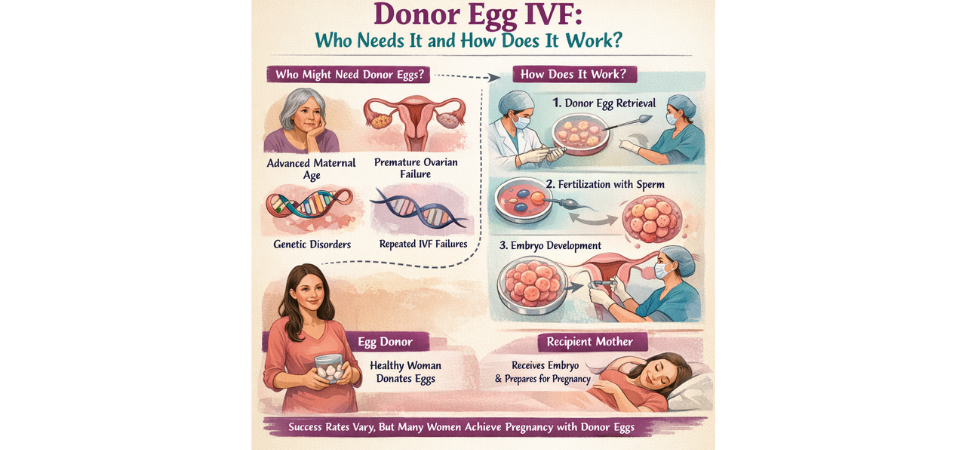
Donor egg IVF — the use of eggs from a younger donor to create embryos for transfer to the intended mother — is among the most effective fertility treatments available. Its success rates substantially exceed those of autologous IVF in the patient populations for which it is most appropriate. And yet it is approached by many couples with a mixture of hope and apprehension — hope because it represents a genuine path to pregnancy when autologous IVF has not worked or is unlikely to work, and apprehension because it involves surrendering the genetic connection to the child through the mother, which is a loss that deserves to be acknowledged and processed with appropriate seriousness.
This article provides the complete, honest picture of donor egg IVF — who needs it, why it works better than autologous IVF for specific patient groups, how the process works, what the success rates are, what the regulatory framework in India requires, and what the psychological experience of making this transition involves.
The goal is not to persuade anyone toward donor egg IVF or away from it. It is to ensure that the couples for whom donor egg IVF is relevant have the complete information they need to make a genuinely informed decision — and to understand, if they choose this path, exactly what it involves.
Who Needs Donor Egg IVF?
Donor egg IVF is most clearly indicated in specific clinical situations where the quality or availability of the intended mother's own eggs is the primary obstacle to a successful IVF outcome.
Women With Severely Diminished Ovarian Reserve
Diminished ovarian reserve — a pool of remaining follicles too small to produce adequate eggs for IVF stimulation — is the most common indication for donor egg IVF. As described in our dedicated article on low AMH, severely low AMH (consistently below 0.3 to 0.5 ng/mL) combined with a poor or absent response to stimulation means that autologous IVF cannot produce the eggs needed for embryo creation.
For these women, donor egg IVF bypasses the reserve limitation entirely. The donor — a young woman with normal ovarian reserve — undergoes stimulation and retrieval, producing multiple eggs that are fertilized with the intended father's sperm. The resulting embryos are transferred to the intended mother's uterus, which in most women with diminished reserve is structurally and functionally normal and capable of supporting a pregnancy.
Women With Premature Ovarian Insufficiency
As described in our article on premature ovarian insufficiency (POI), women who experience premature loss of ovarian function before age 40 typically have very few or no remaining eggs of their own. For women with POI, donor egg IVF is the most clinically effective fertility treatment — offering success rates of fifty to sixty-five percent per transfer, compared to the five to ten percent that autologous IVF achieves in this population.
Older Women With Age-Related Egg Quality Decline
The age-related decline in egg quality — specifically the increasing proportion of chromosomally abnormal eggs as women age — produces increasing IVF failure and miscarriage rates in women over 40 to 43. When autologous IVF cycles consistently produce embryos that are chromosomally abnormal (confirmed by PGT-A), the limiting factor is the quality of the intended mother's eggs — and donor eggs, from a younger donor, offer a meaningfully better per-cycle probability of a euploid embryo and a successful transfer.
The specific age threshold at which donor egg IVF becomes more clinically appropriate than continued autologous IVF is not a fixed number — it depends on the individual's AMH, the response to stimulation, and the pattern of PGT-A results across previous cycles. But for women over 43 to 44 whose autologous cycles have consistently produced aneuploid embryos, the clinical argument for transitioning to donor eggs is compelling.
Women Who Have Failed Multiple IVF Cycles Due to Poor Egg Quality
For younger women whose autologous IVF cycles have consistently produced poor-quality embryos — low fertilization rates, early embryo arrest, consistently poor blastocyst development — when the male factor has been thoroughly assessed and addressed and no uterine or immunological cause has been found, the pattern may reflect an intrinsic egg quality issue. In these cases, donor eggs — which replace the problematic egg quality with the donor's normal egg quality — represent the most clinically rational next step.
Women Who Are Carriers of Serious Genetic Conditions
Women who are carriers of autosomal dominant conditions — such as Huntington's disease or BRCA1/2 mutations — or who are affected by conditions that they would otherwise transmit to children with high probability may choose donor egg IVF specifically to avoid transmitting the condition. PGT-M on their own embryos is an alternative — allowing selection of unaffected embryos — but for some women, particularly those with conditions they are deeply concerned about transmitting, donor eggs represent a more complete solution.
How Donor Egg IVF Works: The Complete Process
Step 1: Donor Selection and Screening
In India, egg donation is anonymous — the donor's identity is not disclosed to the recipient couple, and the recipient couple's identity is not disclosed to the donor. The donor is selected by the ART clinic's egg donor programme, matching on relevant characteristics including blood group, physical characteristics, and educational background where relevant.
Under the ART Regulation Act 2021, egg donors in India must be between 23 and 35 years of age, must be a married woman with at least one living biological child of her own, and can donate eggs a maximum of six times in their lifetime. Donors undergo comprehensive screening — including infectious disease testing (HIV, hepatitis B, hepatitis C, syphilis), genetic screening (karyotype, and specific genetic conditions relevant to the recipient's situation), hormonal assessment (AMH and ovarian reserve), psychological assessment, and general health evaluation.
This screening process protects both the donor's health and the safety of the eggs provided to recipients.
Step 2: Synchronization of Cycles
The donor's stimulation cycle and the recipient's endometrial preparation cycle must be coordinated so that the embryo transfer occurs when the recipient's uterine lining is optimally prepared.
In most donor egg IVF arrangements, the recipient's endometrium is prepared using an artificial hormonal preparation cycle — estrogen to build the endometrial lining, followed by progesterone to prepare it for embryo reception — timed to coincide with the donor's egg retrieval and the subsequent embryo development period.
Step 3: Donor Stimulation and Egg Retrieval
The donor undergoes standard IVF ovarian stimulation — daily gonadotropin injections for ten to fourteen days with monitoring ultrasound scans — followed by trigger injection and egg retrieval under sedation. The eggs are retrieved from the donor and immediately assessed and fertilized by the embryology team.
Step 4: Fertilization and Embryo Development
The donor's eggs are fertilized with the intended father's sperm — typically using ICSI to maximize fertilization rates. The resulting embryos are cultured for five to six days to the blastocyst stage.
If the intended father has male factor infertility — azoospermia, severe oligospermia — the sperm used for fertilization may be surgically retrieved or may be from a previous cryopreservation. The embryos are biopsied for PGT-A if this has been recommended — to identify chromosomally normal embryos for transfer.
Step 5: Embryo Transfer to the Recipient
When the blastocysts are ready — and the recipient's endometrium has been prepared to the appropriate thickness and pattern on monitoring ultrasound — the embryo transfer is performed. The procedure is identical to a standard frozen embryo transfer — a simple, ten-minute procedure without anaesthesia, in which a thin catheter deposits the embryo into the recipient's uterine cavity.
After the transfer, progesterone supplementation continues through the two-week wait and, if the pregnancy test is positive, through the first trimester.
Step 6: Pregnancy Test and Early Pregnancy Monitoring
Fourteen days after the transfer, a beta-hCG blood test confirms whether implantation has occurred. A positive result is followed by serial hCG measurements and an early ultrasound at six to seven weeks to confirm a fetal heartbeat and a normally located pregnancy.
The intended mother — who has been preparing her body, undergoing monitoring, and experiencing the transfer — is the woman who carries the pregnancy, gives birth, and raises the child. The pregnancy is biological, the birth is biological, and the bond formed through gestation and parenthood is as complete as in any other pregnancy.
Success Rates of Donor Egg IVF
The success rates of donor egg IVF are significantly higher than those of autologous IVF in the patient groups for whom it is indicated — and this difference is the primary clinical argument for the transition.
Live birth rate per donor egg embryo transfer in India: Approximately 50 to 65 percent for transfers of good-quality blastocysts from young donors. This rate is essentially independent of the recipient's age — because the success of the transfer depends on the donor's egg quality and the recipient's uterine receptivity, not on the recipient's own ovarian reserve or egg quality. A 45-year-old recipient has the same per-transfer success rate as a 35-year-old recipient, assuming comparable uterine health — because both are receiving embryos of the same donor egg quality.
This age-independence is one of the most clinically significant features of donor egg IVF — it means that the option is genuinely effective for older women who have no viable autologous option, not merely theoretically available.
Cumulative success rates across multiple transfers: For recipients who produce multiple blastocysts from a single donor stimulation — which young, well-responding donors typically do — the cumulative success across two or three transfers approaches eighty to ninety percent. Multiple transfer opportunities from a single donor retrieval significantly improve the overall probability of success.
The Regulatory Framework in India
The ART Regulation Act 2021 governs egg donation in India. The key regulatory requirements relevant to recipients of donor egg IVF are:
Anonymity. Egg donation in India is anonymous. The donor and recipient do not know each other's identities. The child born from donated eggs has the right, on reaching adulthood, to access non-identifying information about the donor — such as medical history — but not identifying information.
Legal parentage. The intended mother — who carries the pregnancy — is the legal mother of the child. The intended father — whose sperm fertilized the donor's egg — is the legal father. The donor has no legal rights or responsibilities in relation to the child.
Regulatory registration. The ART clinic performing the donor egg procedure must be registered under the ART Regulation Act. Registered clinics maintain records of donor and recipient pairings, ensuring that donor eggs from a single donor are not used in more than the permitted number of recipient cycles.
The Psychological Dimension — What the Transition Involves
The decision to use donor eggs involves a transition — from the hope of a biological child genetically connected to both parents, to a child genetically connected to one parent (the father) and to the donor, but carried and born and raised by the intended mother.
This transition is not a small one. For many women, the genetic connection to a child they have been hoping for is deeply important — connected to notions of family continuity, biological inheritance, physical resemblance, and the specific experience of seeing themselves in their child. The prospect of giving this up is a genuine loss, and it deserves to be grieved before the decision to proceed is made.
Several things that are consistently true for couples who make this transition are worth sharing.
The pregnancy experience is fully the intended mother's. Every symptom, every ultrasound, every movement — the complete physical experience of carrying and delivering the baby — is hers. The bond formed through nine months of gestation is a biological bond — formed through the same physiological processes as any other pregnancy — and it is experienced by most women as real and complete.
The genetic connection to the father is complete. For couples, this means the child is fully the biological child of one parent — and the experience of the father's genetic contribution in the child's appearance and character is a bond that connects both parents to the child in ways that are real and significant.
The children themselves, in the research that has followed donor-conceived children across decades, show outcomes of psychological wellbeing and family attachment that are comparable to naturally conceived children. The quality of the parenting relationship — not the genetic connection — is the primary determinant of these outcomes.
And the experience of most couples who make this transition — after the grief of the decision, and after the success of the pregnancy — is that the expected difference between a donor-conceived child and a child they had hoped for is smaller than anticipated. The child is theirs. The pregnancy was theirs. The birth was theirs. The life being lived together is theirs.
None of this means the grief of the decision should be bypassed or minimized. It is real, and it deserves the space and the professional support — from a counselor experienced in donor conception — that it requires. But the experience of the large majority of couples who make this transition, and who reflect on it afterward, is that the path they chose gave them the family they hoped for — in a form they did not initially imagine but that proved, in the living of it, to be complete.
Your Next Step
If you are considering donor egg IVF — whether because of diminished reserve, premature ovarian insufficiency, advanced age with poor autologous outcomes, or repeated IVF failure with consistently poor egg quality — a consultation with Dr. Ashish Soni at Metro IVF in Ambikapur provides the most complete and honest assessment of whether donor egg IVF is the right next step for your specific situation.
The clinical assessment, the honest prognosis, and the compassionate support of the transition — from autologous to donor egg IVF — are all available in Ambikapur.
Metro IVF Test Tube Baby Center Ambikapur, Chhattisgarh metrofertility.in Led by Dr. Ashish Soni — North India's First Fertility Super Specialist
Donor egg IVF offers some of the highest success rates in fertility medicine. Find out whether it is right for you. Book your consultation with Dr. Ashish Soni at Metro IVF today.