
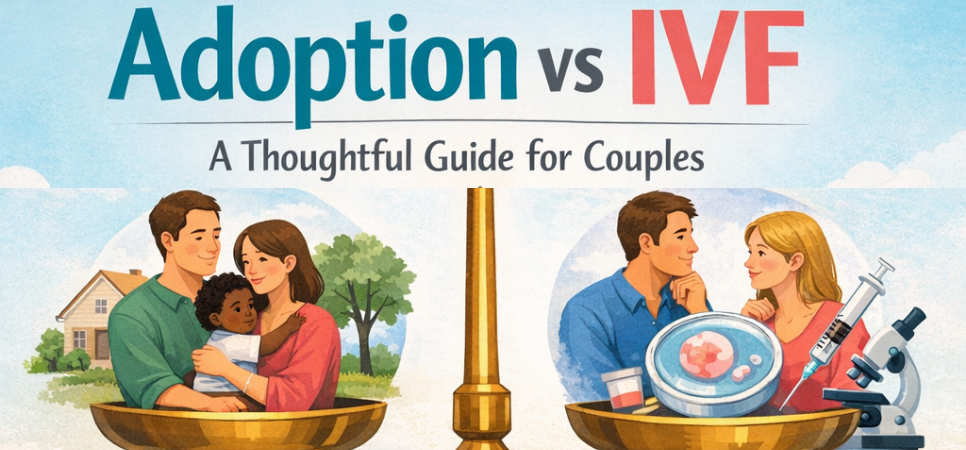
The comparison between IVF and adoption is one that many infertile couples make — and one that is rarely made as clearly, honestly, and thoughtfully as it deserves to be.
It deserves to be made clearly because the two paths are genuinely different — in what they involve, in what they offer, in what they require, and in the kind of family they build. Neither is universally better. Each is better for specific couples, in specific circumstances, with specific values and priorities. Understanding the difference — not abstractly but specifically — is what allows a couple to make a genuinely informed decision about which path is right for them.
It deserves to be made honestly because both paths involve significant commitment and significant uncertainty. IVF is not guaranteed to work, and its failure carries specific costs — financial, physical, emotional. Adoption is not simple or quick, and its process carries specific demands — legal, procedural, emotional — that couples who have not gone through it often underestimate. Neither path is easy, and presenting either as easy would be dishonest.
And it deserves to be made thoughtfully because the decision between them is not purely clinical or purely practical — it is deeply personal, shaped by values and identity and the specific meaning each couple places on biological parenthood, on genetic connection, and on the specific experience of building a family.
This article provides the thoughtful comparison that this decision deserves.
What This Article Is Not
Before the comparison itself, it is worth being clear about what this article does not do.
It does not argue that one path is better than the other. Both IVF and adoption produce families — real, loving, functional families — and the families produced by either path are as fully families as any other. The value of parenthood does not depend on the route through which it was reached.
It does not suggest that a couple who has not tried IVF should consider adoption instead of IVF. For couples who want to pursue biological parenthood — who want to carry a pregnancy, who want a genetic connection to their child, and whose clinical picture supports a reasonable probability of IVF success — IVF is the appropriate first step. Adoption is not a substitute for IVF. It is a different path.
And it does not suggest that adoption is a consolation prize — a fallback for couples who have tried IVF and for whom it has not worked. Adoption is a complete and meaningful path to parenthood in its own right, chosen by couples for a wide range of reasons, and the children who come into families through adoption are as fully children of those families as children born through any other means.
What this article does is help couples understand both paths clearly enough to make the choice — or the sequence of choices — that is genuinely right for them.
Understanding IVF: What the Path Involves
IVF — in vitro fertilization — is the medical process of retrieving eggs from the intended mother (or a donor), fertilizing them with sperm in a laboratory, and transferring the resulting embryos to the uterus. As described in detail throughout this content library, it is a multi-week process involving daily injections, regular monitoring visits, an egg retrieval procedure under sedation, embryo development in a laboratory, and a transfer procedure — followed by a two-week wait and a pregnancy blood test.
What IVF offers: The possibility of a pregnancy — carried by the intended mother — that produces a child genetically related to one or both parents. The experience of pregnancy and birth. The biological connection between parent and child.
What IVF does not guarantee: A successful outcome. The per-cycle live birth rate from IVF in India is approximately 35 to 45 percent for women under 35, declining progressively with age. Many couples require multiple cycles. Some couples exhaust their clinical options without achieving a live birth.
What IVF involves: Financial commitment — typically Rs. 1.2 to 2.5 lakh per cycle at Metro IVF Ambikapur, with additional costs for medications and additional procedures. Physical demand — primarily on the female partner. Emotional intensity — the cycle of hope and uncertainty that each phase involves, and the specific grief of a failed cycle.
The timeline: A single IVF cycle takes four to six weeks from the start of stimulation to the pregnancy test. Multiple cycles may be needed, and the time from the decision to pursue IVF to the birth of a child — accounting for potential cycle failures, frozen embryo transfers, and the pregnancy itself — is typically one to three years for couples who ultimately succeed.
Understanding Adoption: What the Path Involves
Adoption in India is regulated by the Central Adoption Resource Authority (CARA) — the statutory body under the Ministry of Women and Child Development that governs the adoption of Indian children. The process is formal, legally structured, and requires compliance with specific eligibility criteria, procedural steps, and timelines.
The legal framework. Domestic adoption of Indian children is governed by the Juvenile Justice (Care and Protection of Children) Act 2015 and the Adoption Regulations issued under it. The process involves registration with CARA, completion of a Home Study Report (an assessment of the prospective adoptive parents' suitability conducted by a licensed agency), matching with an available child, and a legal order from the court making the adoption final.
Eligibility criteria for prospective adoptive parents in India. Both married couples and single individuals can adopt in India, subject to specific eligibility criteria. Married couples must have been married for at least two years. Both partners must be mentally and physically fit. Age criteria apply — the combined age of the couple must not exceed a specified limit relative to the child's age. Specific age limits also apply for adopting children of different age groups.
The timeline. Adoption in India is not a quick process. The current average waiting time — from registration with CARA to the matching of a prospective adoptive parent with a child — is typically two to five years for healthy infants, and shorter for older children or children with special needs. The total timeline from the decision to adopt to the legal finalization of the adoption is typically three to five years for a healthy infant.
The matching process. Prospective adoptive parents are matched with children through the CARA system on a first-come, first-served basis according to registration date. The couple does not choose a specific child — they receive a referral from CARA and have the opportunity to accept or decline. Most couples accept.
What adoption offers. A child — real, complete, theirs — who needs a family. The experience of parenthood in its full form. A family formed by choice, by commitment, and by the legal and emotional bond that adoption creates.
What adoption does not offer. A genetic connection to the child. The experience of pregnancy and birth. The biological continuity between generations that some families place significant value on.
What adoption involves. A formal process with legal requirements, documentation, home study assessment, and waiting periods. The emotional experience of the waiting period — which can be longer than an IVF journey — and the specific emotional experience of receiving a referral and saying yes to a child who was born to someone else.
The Dimensions of the Comparison
The Genetic Connection
IVF — when successful with autologous eggs and sperm — produces a child genetically related to both parents. This genetic connection is important to many couples — it is the specific aspiration of biological parenthood that infertility has frustrated, and IVF is the medical means of fulfilling it.
Adoption produces a child with no genetic connection to either adoptive parent. For couples for whom biological parenthood — the genetic continuity, the possibility of seeing themselves in their child, the specific meaning of biological family — is central to what they are hoping for, this difference matters. It is not a lesser form of parenthood. But it is a different one, and the difference deserves to be acknowledged rather than glossed over.
The Physical Experience
IVF involves significant physical demand — primarily on the female partner — across the stimulation, retrieval, and transfer phases. Adoption involves no physical medical procedures. For women who have already been through the physical demands of multiple IVF cycles and who find themselves exhausted by the medical process, the absence of physical medical intervention in adoption may itself be a factor in the decision.
The Timeline
IVF can be initiated quickly — within weeks of the clinical decision to proceed. The timeline from the start of an IVF cycle to a live birth — if the first cycle succeeds — is approximately one year. If multiple cycles are needed, the timeline extends accordingly.
Adoption involves a formal registration and waiting process that, for healthy infants, typically extends two to five years. For couples in their late thirties or early forties who are weighing the two paths, the relative timelines — IVF potentially producing a child within one to two years, adoption potentially taking three to five years — are a genuinely relevant consideration.
The Financial Commitment
IVF is financially significant — a typical complete cycle at Metro IVF costs Rs. 1.5 to 2.5 lakh, and multiple cycles may be needed. The total financial commitment of an IVF journey varies widely depending on the number of cycles required and any additional procedures involved.
Adoption involves legal and procedural costs that are significantly lower than the medical costs of IVF — though the specific costs depend on the legal representation required and the fees of the licensed adoption agency. The total financial commitment of the adoption process is generally lower than the total financial commitment of an extended IVF journey.
The Emotional Experience
The emotional experiences of IVF and adoption are different in character rather than in magnitude.
IVF involves a recurring cycle of hope and uncertainty — the hope of each cycle, the specific anxiety of each waiting period, the grief of each failed cycle. The emotional experience is tied to the clinical process in ways that produce a specific emotional rhythm that many couples find exhausting across multiple cycles.
Adoption involves a different emotional experience — the formal application process, the home study assessment, the waiting period, the referral that arrives after months or years of anticipation. The emotional experience of adoption is less clinically structured and more procedurally open-ended — characterized by the long waiting of a process whose timeline cannot be precisely predicted.
Both involve uncertainty. Both involve hope. Both involve the possibility of disappointment — IVF through failed cycles, adoption through delays, the possibility of a failed match, or other procedural complications.
The Societal and Family Context in India
In the Indian context — where fertility is a significant social expectation, where biological parenthood is culturally weighted, and where the families of both partners have opinions about the couple's path to parenthood — the decision between IVF and adoption is made in a social context that is part of the decision.
Families who are aware of the couple's infertility may have strong preferences — often for IVF as the path that produces a biological grandchild or niece or nephew — that add social pressure to an already emotionally complex decision. Couples navigating this social context deserve to make their decision on the basis of their own values and priorities rather than the expectations of others — but acknowledging that those expectations exist, and planning how to manage them, is part of realistic preparation for either path.
Choosing Both — The Sequential Approach
Many couples do not experience this as a choice between two mutually exclusive options — they experience it as a question of sequence. They pursue IVF first — with the specific intention of attempting biological parenthood through the clinical route — and make a decision about adoption only after the IVF journey has reached a conclusion, one way or another.
This sequential approach is both common and clinically rational. It allows couples to give biological parenthood the chance the medical technology offers, while holding adoption as a genuine alternative that becomes more salient as the IVF journey reaches its natural end.
The risk of the sequential approach is timing — particularly for couples who begin IVF late, who require many cycles, and who then begin the adoption process at an age that is closer to the eligibility limits. For couples for whom the adoption path is genuinely being considered as a real alternative — not merely as a theoretical fallback — beginning the adoption registration process earlier rather than later is worth considering, because the waiting period begins from the date of registration and cannot be shortened.
What the Decision Actually Depends On
The decision between IVF and adoption ultimately depends on the answers to two questions that only the couple themselves can answer.
How important is the biological connection — to both parents, or to one — in what they are hoping for from parenthood? And what kind of journey — in terms of its emotional character, its physical demands, its timeline, and its financial requirements — are they willing and able to sustain?
There is no universal right answer to these questions. There is only the answer that is right for the specific couple, in their specific circumstances, with their specific values.
At Metro IVF, these questions are part of the broader conversation that Dr. Soni has with couples who are evaluating their options — not to prescribe an answer, but to ensure that the clinical information about what IVF can offer is combined with the honest acknowledgment that IVF is not the only path, and that the paths that lie alongside it are not lesser alternatives.
Your Next Step
Whether you are at the beginning of considering IVF, deep in the middle of a fertility treatment journey, or wondering whether adoption is the right direction — the starting point is the same: a conversation with a specialist who will give you the most honest and complete clinical picture of your IVF prognosis.
That clinical picture is the foundation of the comparison. Knowing what IVF can realistically offer — specifically, for your situation — is what makes the comparison between IVF and adoption genuinely informative rather than merely abstract.
Metro IVF Test Tube Baby Center Ambikapur, Chhattisgarh metrofertility.in Led by Dr. Ashish Soni — North India's First Fertility Super Specialist
Whatever path to parenthood is right for you, the clinical picture is where the decision starts. Book your consultation with Dr. Ashish Soni at Metro IVF today.